As the weather begins to warm up and we head into Spring, astrophotographers eagerly anticipate the arrival of galaxy season. This is the wonderful time of year when the Earth faces away from Milky Way’s spiral arms and out into deep space, allowing a host of other galaxies to become visible to stargazers.
I don’t know about you, but the idea of photographing another galaxy full of countless stars and unknown worlds makes me feel very small (in a good way). This is one of the many amazing feelings of awe and wonder experienced by backyard amateur astronomers and photographers alike.
Galaxy season typically runs from March to May in the Northern Hemisphere. It is during this time that we get breathtaking views of the gems that deep space has to offer. Galaxy season is a great time for astrophotography. With a camera and tripod, you can capture stunning images of the far away galaxies – galaxies that are home to trillions of stars just like our own, and possibly countless other worlds and beings just like us.
Although galaxies are incredibly large, they are millions of light-years away, and so they require telescopes with a very long focal length to view and capture them. However even with a small refractor, we can still capture some stunning photographs of these other worlds. A very popular target during season is the galactic pair of Messier 81 and 82 – The Cigar and Bodes galaxies.

I captured the image above using a William Optics Zenithstar 73 apochromatic refractor, a one shot colour dedicated astronomy camera, and an Optolong L-Pro light pollution filter. At a modest focal length of 440mm, both galaxies can be seen floating effortlessly in a vast expanse of deep space, surrounded by an ocean of colourful stars, each one a possible Sun to some distant civilisation.
Perhaps the most famous target during galaxy season is the Andromeda Galaxy. With binoculars or a telescope, you can see its spiral arms and even some of its smaller companion galaxies. However, similarly above, using a camera, we can take several long exposure images of the galaxy and combine them together to improve the signal-to-noise ratio. This allows us to maximise the signal or light from the galaxy, whilst averaging out the background noise from the sky. The Andromeda galaxy is one of my favourite jewels in the night sky. Ever since I was a child, I dreamed of being able to take a photo of it, and in summer of 2022, I was able to capture the below image.

Messier 31 – The Andromeda Galaxy
Another favourite of mine is the Pinwheel Galaxy. Located in the constellation Ursa Major, the Pinwheel galaxy is almost 21 million light-years away from Earth. Lying face-on, it provides us wonderful views of its complex spiral structure, and perfectly highlights the vastness and beauty of our cosmos.
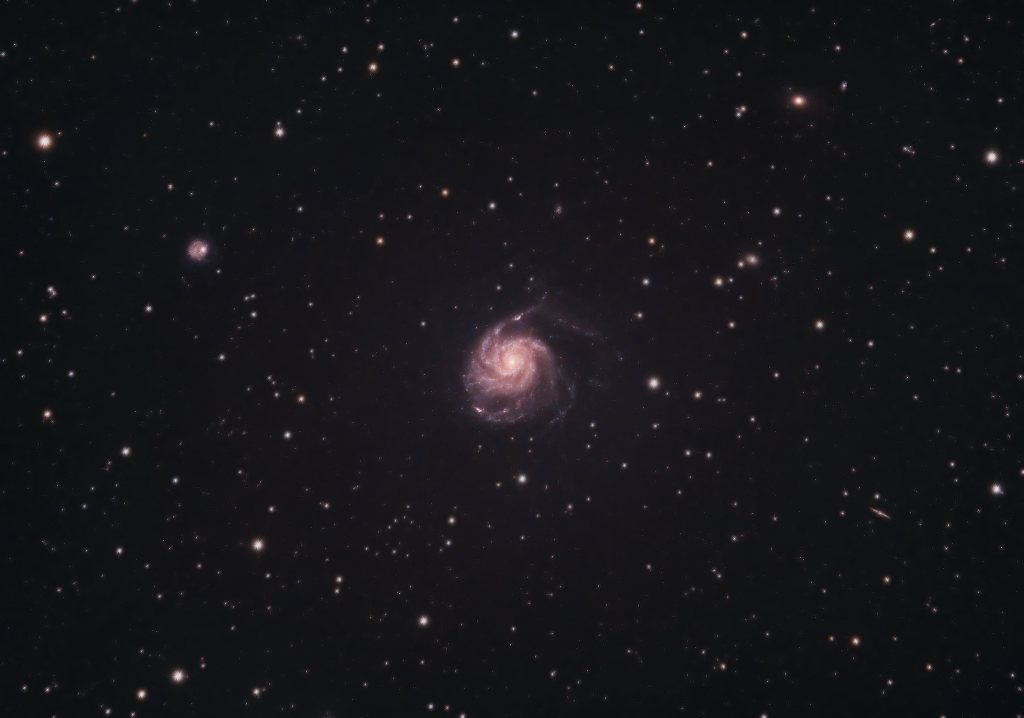
Other popular targets include the Whirlpool Galaxy, located in the constellation Canes Venatici. This galaxy is notable for its striking spiral arms and the companion galaxy located just off its side. The Sombrero Galaxy, located in the constellation Virgo, is another favorite for its distinct shape and bright nucleus.
In addition to stargazing and astrophotography, there are many events and activities during galaxy season. Astronomy clubs and organizations often host star parties and observing sessions, where you can meet other astronomy enthusiasts and learn more about the night sky. There are also many online resources and apps that can help you identify and locate galaxies in the sky.
Galaxy season is a wonderful time for astronomy enthusiasts to observe and appreciate the beauty of our galaxy and beyond. Whether you’re stargazing, taking astrophotographs, or attending events, there are many ways to participate in this exciting time of year. So grab your telescope and head outside to explore the wonders of the universe.
 Ancient Canvas Photography