Mono?! Why would I want a black and white photo?!
If you’re thinking of upgrading from a DSLR to a dedicated astronomy camera, you would have noticed the wide variety of monochrome cameras available. You might ask yourself why anyone would want to image this wonderful, bright and colourful universe in black and white – let’s find out why!
One Shot Colour
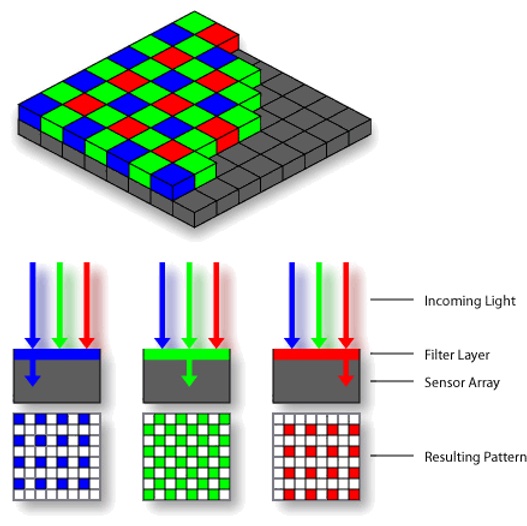
One shot colour astronomy cameras are similar to DSLR’s. They shoot full colour images, but they have several advantages over DSLR’s such as much greater quantum efficiencies, full sensitivity to Ha wavelengths and on-board cooling systems.
Colour cameras are able to produce colour images due to the bayer matrix that sits on top of the sensor. The bayer matrix is a primary colour filter that only lets Red, Green, and Blue wavelengths hit certain pixels – see the image to the right. This occurs on a micro scale – eventually building up a full colour image.
This makes it simple to collect data. Just shoot your target and stack the frames to build up the signal. That’s it!
Monochrome cameras
Monochrome cameras on the other hand don’t have a bayer filter. The light hits the raw sensor resulting in a monochrome image. However this has several benefits, and they’re all to do with narrowband imaging…
Most nebula emit in wavelengths such as Ha and OIII. To get the best results, it’s best to use a Ha or OIII filter – these filters only let these specific wavelengths through, blocking out all other light pollution and creating excellent contrast.
Using an Ha narrowband filter with a colour camera means that only the red pixels will actually be doing anything – the blue and green pixels won’t be seeing any light because the Ha filter only lets the red hydrogen light through! This means only 25% of the sensor is creating any signals.
With a monochrome camera, because there’s no bayer filter, the whole sensor is available to collect the red Ha light, producing a much greater signal. So in the end, you get bright, vibrant image. You can spend a few hours collecting Ha data, and then swap to an OIII filter to collect the deep blues and greens.
I’ll take 3 monochromes please…
Not so fast! There’s always a price to pay! Whilst monochrome cameras can capture more data, there’s a bit more to understand.
In order to capture colour data, monochrome camera’s need filters – for narrowband imaging such as emission nebula, you’ll need Ha, OIII and SII filters. You’ll also need to spend time shooting your target with each filter to build up a full colour image. The same applies for broadband targets such as galaxies. For these, you’ll need standard Red, Green & Blue filters.
Here lies the problem – what happens if you’ve captured your Ha and SII data, but the clouds roll in before you get the chance to capture your OIII data? – You’ll have to wait for another clear night to carry on your project! This doesn’t mean you can’t work with the data you’ve got – your project just won’t be complete.
There’s still more…
You can correct many things in post, but out of focus frames you cannot. No filter will be exactly the same, which means that each time you change filters, you’ll also need to refocus your scope. It also means that you’ll need to take flat calibration frames for every single filter. This becomes very cumbersome when you have to manually keep changing filters, so you use a filter wheel.
Filter wheels allow multiple filters to be installed within them. The wheel then rotates to whichever filter is required and is controlled by a computer. This an additional cost and weight to consider.
 Ancient Canvas Photography